
Graphite-Plugged Bronze Slide Plates with Countersunk Mounting Holes
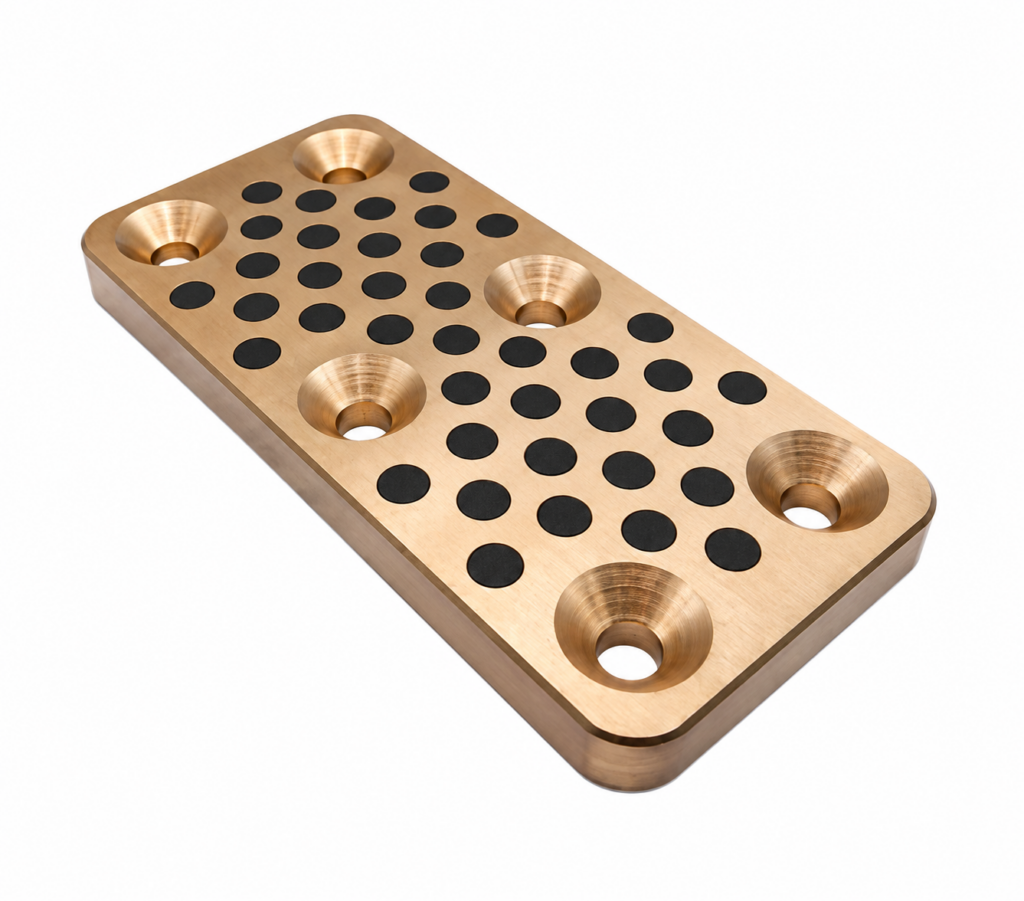
BONIU supplies graphite-plugged bronze slide plates with countersunk mounting holes for drawing-defined sliding and wear applications. The copper-alloy plate contains embedded graphite solid lubricant, while conical fixing recesses accommodate matching fastener heads. Send your drawing, quantity and operating conditions to confirm the plate dimensions, material and mounting arrangement.
Countersunk Bronze Slide Plates for Machine Guides
A machine guide plate enquiry should describe the guide arrangement as well as the plate dimensions. Identify whether the part supports a sliding carriage, provides lateral guidance or serves as a replaceable wear surface. Confirm the direction of motion and the clearance required throughout the complete travel.
Fastener heads and the sliding path
Provide the screw-head dimensions and countersink included angle. Specify the installed head position relative to the bearing face, including the required clearance under the expected assembly tolerances. A screw that initially appears flush may still interfere with the mating member if its geometry or seating differs from the drawing.
Support, material and wear inspection
Define the backing-face support and specify thickness tolerance and flatness where they control the assembly clearance. Provide the mating surface material and finish, load, speed, duty cycle and contaminants. Confirm the alloy and graphite specification for quotation; the presence of graphite alone does not establish dry-running suitability or a maintenance interval.
Send the working-face drawing, countersink details, hole positions and quantity for a custom bronze slide guide plate quotation. For press-tool applications, review the stamping die wear plate range. For a circular axial contact arrangement, review our grooved bronze thrust plates.
Graphite-Plugged Bronze Slide and Wear Plates
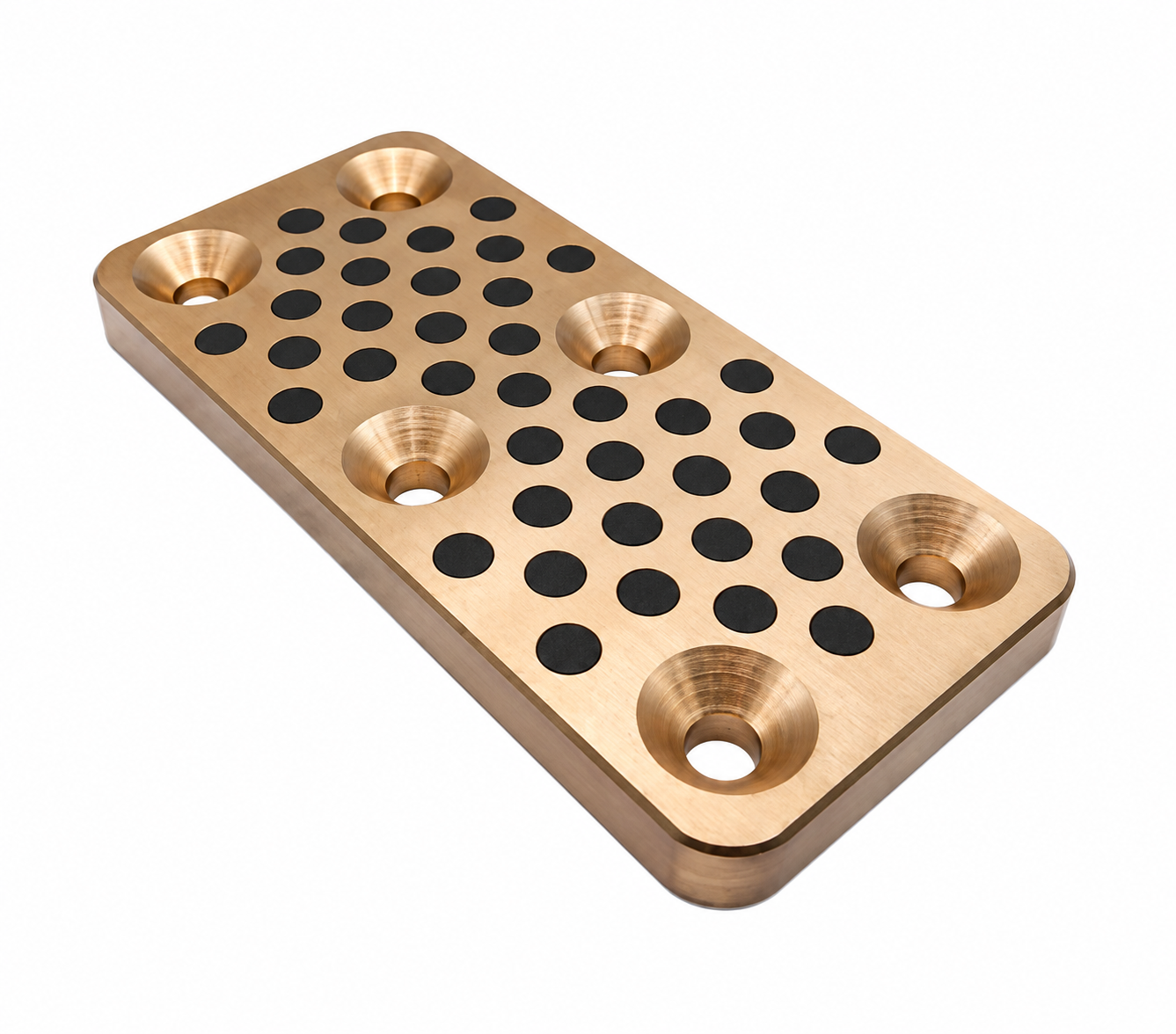
The product photograph shows a rectangular plate with rounded corners, graphite plugs across its working face and six countersunk mounting holes. The metal body supports the specified contact load, and the embedded graphite supplies solid lubrication at the intended sliding interface.
Potential enquiries include slide guides, tooling wear surfaces, machine slides and other assemblies requiring a replaceable bearing plate. Suitability depends on the load, contact area, motion, mating surface and working environment. Confirm these conditions before selecting the alloy, graphite pattern or plate thickness.
The photograph illustrates the construction and hole arrangement. It does not establish standard dimensions, an alloy grade or a load rating. The material and graphite specification are confirmed against the agreed drawing and order requirements.
Countersunk Mounting Holes and Screw-Head Clearance
Each countersunk hole has a conical recess for a matching fastener head. Specify the through-hole diameter, included countersink angle and recess diameter or depth together with the screw specification. Hole positions must be dimensioned from clear datums so they match the supporting component.
Where the mating part passes over the fixing positions, confirm the installed screw-head position relative to the sliding face. The fasteners must remain clear of the moving component throughout its travel. Head clearance, plate support, tightening torque and thread engagement should be defined in the assembly design.
The open fixing holes and filled graphite locations serve different purposes. Maintain the approved separation and layout when specifying custom holes or plug patterns. Do not add fixing holes through graphite plugs or alter the working surface without reviewing the bearing design.
For the broader range, see our graphite-plugged bronze wear plates or browse the product catalogue.
Dimensions and Quotation Checklist
Send a dimensioned drawing and identify the working face, sliding direction and installation datum. Confirm whether the supplied six-hole example matches your requirement or whether a different arrangement is needed.
| Feature | Information to provide |
|---|---|
| Plate geometry | Length, width, thickness, corner radii, chamfers and any pockets or cut-outs. |
| Mounting pattern | Number of holes, centre distances, edge distances, orientation and position tolerances. |
| Countersink | Through-hole diameter, included angle, recess diameter or depth and mating screw details. |
| Working surface | Sliding face, contact area, flatness, thickness tolerance and mating surface requirements. |
| Material and graphite | Copper alloy grade, graphite specification and approved plug arrangement. |
| Operating conditions | Load, sliding speed, stroke, duty cycle, temperature, contamination and lubrication requirements. |
| Order details | Quantity, drawing revision, inspection documents, packaging and destination. |
For replacement parts, provide the existing drawing or measured sample dimensions together with the mating component and working conditions. Similar appearance alone does not establish interchangeability.
Installation and Sliding-Surface Checks
Clean and deburr the backing surface, mounting holes and fasteners. Support the plate evenly against the specified mounting face and check that debris or burrs cannot create local high spots. Avoid striking the graphite plugs or clamping the plate in a way that distorts its working surface.
Use screws with the specified head geometry and follow the assembly drawing for tightening torque and sequence. Verify that each head seats correctly and remains at the required position below or relative to the sliding face. Check the complete travel of the mating component for interference.
Review the counterface material, finish and alignment so the intended contact area carries the load. Confirm running-in, lubrication and maintenance requirements for the selected alloy and graphite specification. Self-lubricating construction still requires assessment of contamination, heat, wear and corrosion in service.
Frequently Asked Questions
What are the conical holes used for?
They are countersunk fixing holes for matching fastener heads. Their angle, diameter, depth and position must match the approved screw and mounting design.
Are all plates supplied with six holes?
The photograph shows a six-hole example. Send your drawing to confirm the required hole quantity, positions and countersink geometry for quotation.
What do the black plugs do?
They are embedded graphite solid lubricant at the specified bearing face. The alloy and graphite arrangement are confirmed for the intended sliding duty.
Can the screw heads sit flush with the working face?
The required head position must be specified and checked against the mating part’s travel and clearance. Do not assume that any countersunk screw will fit safely.
Can BONIU supply a custom size or hole pattern?
Send the complete drawing, material requirements, quantity and working conditions. BONIU will review the plate geometry and mounting details before confirming the quotation.
Request a Countersunk Slide Plate Quote
Send your drawing, quantity, mounting screw specification and sliding conditions. BONIU will confirm the graphite-plugged plate construction and countersunk fixing arrangement for your order.